
AKA
Hypnosis
Focus
Subconscious learning through reorganization of implicit, embodied patterns
Principal Metaphors
- Knowledge is … subconscious, embodied patterning (that organizes perception, emotion, and response)
- Knowing is … enacting (subconscious organization in real time)
- Learner is … a subconscious, self-organizing system (of implicit memory and meaning)
- Learning is … transforming subconscious patterns (through lived and felt experience)
- Teaching is … structuring conditions for subconscious reorganization
Originated
19th century
Synopsis
Hypnotherapy may be understood as an applied approach to learning that operates at the level of implicit, embodied, and narrative organization. By engaging focused attention, imagery, metaphor, and suggestion, Hypnotherapy facilitates shifts in the patterns through which experience is enacted. Narrative, metaphor, and symbolic processes play a central role in how meaning is formed and transformed – extending frameworks that highlight the central role of sub-conscious processes in learning and change, such as Enactivism and Narrative Constructivism (under Identity Discourses),
Foundational elements, subdiscourses, and associated discourses include:
- Hypnosis (James Braid, 1840s) – a state of mind characterized by narrowly focused attention, limited contextual awareness, and high inclination to act on suggestion. Alternatively, Hypnosis might be defined as a capitulation of one’s agency. There is much debate on such matters, with two major perspectives prominently represented (i.e., Altered State Theories and Non-State Theories; see below). Associated discourses include:
- Altered State Theories – perspectives on Hypnosis that see the associated state of mind in terms of a trance or other altered state of consciousness
- Neodissociation Theory (Ernest Hildard, 1970s) – the proposal that Hypnosis involves a temporary division of consciousness in which some mental processes become dissociated from conscious awareness and voluntary control
- Non-State Theories – perspectives on Hypnosis that see the associated state of mind in terms of role play, placebo effect, or other form of imaginative self-delusion
- Re-Patterning – a change process that shifts entrenched ways of responding by reorganizing the underlying patterns through which experience and action are coordinated. The emphasis is on changing the system’s organization (how responses are produced), rather than adding new propositional knowledge.
- Suggestibility (Suggestion) – the quality of being disposed to alter one’s memories, opinions, and activities to align with the persistent suggestions of others
Commentary
Hypnotherapy brings together perspectives from Cognitive Science, Narrative Theory (under Identity Discourses), and Psychotherapy to clarify how Hypnotherapy conceptualizes subconscious, embodied, and implicit processes. It also highlights points of alignment and divergence with established educational theories. However, Hypnotherapy also raises several theoretical and empirical tensions:
-
- The concept of the “subconscious” lacks a consistent definition within Cognitive Science, often overlapping with constructs such as implicit processing or non-declarative memory.
- Empirical research demonstrates variability in hypnotic responsiveness and outcomes, with ongoing debate regarding mechanisms of action.
- Its historical positioning outside mainstream educational discourse has limited its integration into broader theories of learning.
Historically, Hypnotherapy emerges from earlier attempts to understand altered states and their therapeutic potential, including:
-
- Mesmerism (Franz Anton Mesmer, 1770s) – a theory and practice a claiming that illness can be treated by manipulating an invisible “animal magnetism” or fluid. (The fluid theory was rejected, but some Mesmerism techniques resemble later hypnotic induction.)
- Neurypnology (James Braid. 1840s)—literally, “nervous sleep” – an early characterization of Hypnosis as a physiological/psychological state induced by focused attention and suggestion, distinct from Mesmerism
- Ideomotor Theory (William Benjamin Carpenter, 1860s) – the suggestion that, without inhibitions, mental representations spontaneously prompt actions. Ideomotor Theory is the basis of early theories of Hypnosis.
- Self-Hypnosis (Autosuggestion) (Émile Coué, 1890s) – a self-induced, focused state of relaxation and heightened suggestibility, used to influence thoughts, feelings, or behaviors. Mirroring techniques used in clinical hypnosis, Self-Hypnosis involves concentrating attention, often through guided imagery or repetition, to bypass critical awareness and access the subconscious.
These precursors continue to inform contemporary understandings of hypnosis as an attentional and experiential phenomenon rather than a physical force.
While modern clinical hypnosis developed within Western medicine and psychology in the 18th and 19th centuries, many scholars note that trance-based healing practices long predate modern hypnosis and appear across Indigenous, ceremonial, and shamanic traditions worldwide. Rhythmic sound, focused attention, guided imagery, ritual, storytelling, and altered states of consciousness have been used for healing and transformation in many cultures for thousands of years. Contemporary hypnotherapy may therefore be understood not as something entirely new, but as a modern clinical expression of much older human practices involving trance, healing, and consciousness.Authors and/or Prominent Influences
Jean-Martin Charcot, Sigmund Freud, Milton Erikson
Status as a Theory of Learning
Hypnotherapy is an approach to change that engages implicit, embodied, and pre-reflective processes through focused attention, imagery, and suggestion. Although historically situated within clinical practice, it can be understood more broadly as a mode of learning that operates at the level of sub-conscious organization. Contemporary cognitive science provides a useful bridge for this understanding. In particular, Enactivism emphasizes that cognition is enacted through dynamic interactions of brain, body, and environment, while Narrative Constructivism (under Identity Discourses) highlights the role of narrative and symbolic processes in structuring meaning.
Status as a Theory for Teaching
Hypnotherapy facilitates conditions in which attention, imagery, and experience support shifts in underlying patterns of meaning and response. Hypnotherapy therefore contributes a distinct orientation to teaching. It foregrounds the role of implicit processes, and the possibility of change through their reorganization, while remaining outside conventional educational theory.
Status as a Scientific Theory
Hypnotherapy is not a unified scientific theory. It is an applied practice drawing on multiple frameworks, including cognitive, behavioural, and neurophysiological accounts of attention, perception, and implicit processing. Its foundations intersect with research on Hypnosis, particularly in relation to focused attention, suggestion, and altered patterns of brain activity.
Empirical evidence supports the efficacy of Hypnosis-based interventions for conditions such as anxiety, pain, and stress, although variability in responsiveness remains. At the same time, findings from neuroscience are providing increasing insight into underlying mechanisms, including changes in functional connectivity, attentional control, and the modulation of perception and affect. Hypnotherapy is thus supported by a growing body of research but remains theoretically pluralistic. Its status continues to evolve as research further clarifies the role of implicit and non-conscious processes in cognition and change.
Subdiscourses:
- Alpha Waves
- Altered State Theories
- Beta Waves
- Conscious
- Delta Waves
- Hypnosis
- Mesmerism
- Neodissociation Theory
- Neurypnology
- Non-State Theories
- Re-Patterning
- Self-Hypnosis (Autosuggestion)
- Subconscious
- Suggestibility
- Theta Waves
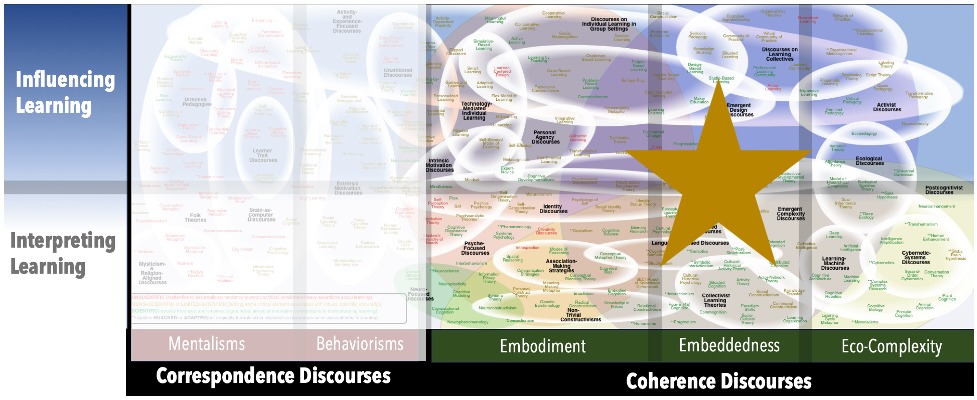
Map Location
Please cite this article as:
Davis, B., & Francis, K. (2026). “Hypnotherapy” in Discourses on Learning in Education. https://learningdiscourses.com.
⇦ Back to Map
⇦ Back to List