
AKA
Ecological Theory of Information Pickup
Focus
Redefining “perception of information” in terms of occasioning learners rather than knowledge transferPrincipal Metaphors
- Knowledge is … scope of possible actions and interpretations
- Knowing is … coherent web of interpretations
- Learner is … an interpreter (individual)
- Learning is … selecting interpretations (of information/triggers)
- Teaching is … designing (affordances), occasioning, triggering
Originated
1960sSynopsis
Information Pickup Theory begins by redefining both information and pickup. Information is understood in terms of triggering the perceiver – that is, information is only information if it is noticed by the learner and occasions some manner of response. Information is thus not inherently meaningful. Rather, meaning arises in the interpretive possibilities triggered in the knower by the information. Pickup is similarly defined. Here it means something like “noticing” or “resonating”; it is not about “picking up something,” but “picking up on something.” Information becomes information through pickup. Perceiving is thus more like “resonating” than “taking in” or “processing.” Precursors to Information Pickup Theory include:- Direct Perception Theory (James J. Gibson, 1950s)– the view that perception is immediate and unmediated by mental representations. Organisms directly detect affordances – action-relevant information – available in the environment through sensory engagement, rather than constructing internal models of the world.
- Ecological Perception (James J. Gibson, 1950s) – the suggestion that organisms perceive environments directly in terms of meaningful, actionable possibilities. Perception is shaped by the relation between organism and world, not by passive sensory input later interpreted by the mind.
- B-Perception (Being-Perception) (Abraham Maslow, 1960s) – a receptive, holistic, appreciative mode of perception in which things are experienced as valuable in themselves, independent of judging, categorizing, or using it for personal purposes
- D-Perception (Deficiency-Perception) (Abraham Maslow, 1960s) – a need-driven mode of perception in which one perceives the world primarily in terms of satisfying wants, reducing deficiencies, or achieving goals
- Information Foraging Theory (Peter Pirolli, Stuart Card, 1990s) – a perspective on how humans seek, evaluate, and consume information by maximizing gains (useful information) while minimizing costs (time, effort). Information Foraging models behavior similarly to animals foraging for food.
- Stimulus Array – the range of possible perceptions for an agent in an environment – which will vary across agents
Commentary
Information Pickup Theory was articulated as a critical response to all Mentalisms, and to Cognitivism in particular. The theory explicitly rejects the assumption of Cognitivism (and other Brain-as-Computer Discourses) that learning is taking in information – a conception in which “information” is implicitly understood as some sort of matter that flows from the outside to the inside. Information Pickup Theory was an important precursor to Embodied Cognition, but it was frustrated by the need to invent a new vocabulary – in large part by redefining popular terms – in order to disrupt prevailing perspectives.Authors and/or Prominent Influences
James J. GibsonStatus as a Theory of Learning
Information Pickup Theory is a theory of learning – or, perhaps more appropriately, a theory of perception that sets the stage for a theory of learning.Status as a Theory of Teaching
Information Pickup Theory is not a theory of teaching, although it was the grounding for later perspectives that are more oriented toward teaching (see Affordance Theory).Status as a Scientific Theory
Information Pickup Theory is not often cited in current discussions of learning, but it played an important and highly influential role in the emergence of Embodied Cognition, Cognitive Science, and other Postcognitivist Discourses. The challenges it presented to prevailing discourses on learning was pivotal, especially in the radical suggestion that supposedly oppositional Mentalisms and Behaviorisms were rooted in the same entrenched, commonsensical assumptions. It helped to set a new standard for learning theories around critical attentiveness to metaphors and underlying assumptions.Subdiscourses:
- B-Perception (Being-Perception)
- D-Perception (Deficiency-Perception)
- Direct Perception Theory
- Ecological Perception
- Information Foraging Theory
- Stimulus Array
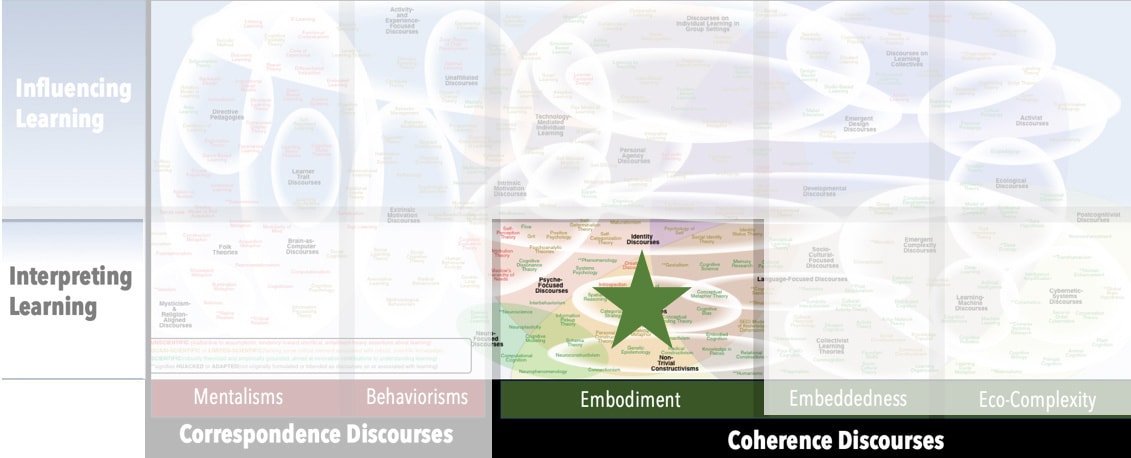
Map Location
Please cite this article as:
Davis, B., & Francis, K. (2026). “Information Pickup Theory” in Discourses on Learning in Education. https://learningdiscourses.com.
⇦ Back to Map
⇦ Back to List