
Focus
Making sense of existence without relying on dualist assumptionsPrincipal Metaphors
- Knowledge is … the continuity of forms
- Knowing is … being
- Learner is … any form acting with/in other forms
- Learning is … becoming
- Teaching is … N/A
Originated
Ancient (entrenched in the language)Synopsis
Materialisms assert that everything in the universe is matter-based – and so, in one swoop, reject almost all Correspondence Discourses and their associated dualisms. All Materialism reject notions of spirits, spirituality, fates, and deities as useful or valid explanatory devices. Rather, phenomena such as cognition, ideas, and consciousness are seen as the result of material interactions:- Supervenience (Donalld Davidson, 1970s) – in the context of discourses on learning, the assertion that no mental change occurs without a physical change; more broadly, a descriptor of any situation in which one set of properties depends on another
- Dialectical Materialism (Marxist Dialectics) is associated with most varieties of Critical Pedagogy. It is focused on such material conditions as social class and power structures in its efforts to prompt societal evolutions toward more just forms of social organization.
- Eliminative Materialism (Eliminativism) focuses mainly on concepts associated with “mind” Asserting that Folk Theories are mistaken, it looks to Neuroscience to one day reveal that such notions as intention, belief, desire, and love are by-products of inadequate natural languages rather than materially rooted.
- New Materialisms amplify the orienting tenets of Materialisms, with a particularly enthusiastic embrace of eco-centrism (i.e., displacing humans as the centre of inquiry) that emphasizes the rejection of human/non-human, animate/inanimate, and other dualisms already problematized by Materialisms. Most often, New Materialisms are aligned with Post-Structuralism.
- Ontological Materialism – the perspective that all phenomena – including those that are perceived or interpreted as mental, spiritual, and/or metaphysical – are due to matter and the interactions among matter
- Scientific Materialism (George Santayana, 1930s) – a phrase used to characterize the worldview of research scientists whose research is rooted in or aligned with Materialisms
- Socio-Materialism (Sociomaterialism; Sociomateriality) (Wanda Orlikowski, 2000s) – a perspective that frames human actions and interactions as constituted by the sociality and materiality of technologies and organizations
- Naturalism (Charles Albert Dubray; 1910s) – the view that only natural laws operate in this universe – entailing rejections of the supernatural, the spiritual, the metaphysical, and the idealistic. Related discourses include:
- Natural Philosophy (Philosophy of Nature) – the philosophical study of physics, which dominated discussions of rational and empirical inquiry prior to the Scientific Revolution and the emergence of modern science
- Naturalized Epistemology (W.V.O. Quine, 1960s) – a descriptive term applicable to any perspective on knowledge production that focuses on empirical methods of the natural sciences
- Cooperative Naturalism – the perspective that discussions of Epistemology should be informed by Cognitive Science research into how humans are structured to perceive/interpret the universe
- Replacement Naturalism (W.V.O. Quine, 1960s) – the conviction that perspectives and methodologies based in the natural sciences should replace more philosophical treatments of Epistemology
- Substantive Naturalism – a “hard” Naturalism, founded on the assertion that the only facts are those that can be verified through the methods of the natural sciences
- Physicalism (Otto Neurath, Rudolf Carnap; 1930s) – often used interchangeably with Materialisms, Physicalism is sometimes distinguished as being more explicit in its alignment with physics and its considerations of more than matter (e.g., energy, fundamental laws). Subdiscourses include:
- Non-Reductive Physicalism (Donald Davidson, 1970s) – the view that everything is physically based, yet mental states cannot be fully reduced to physical properties. Specific examples include:
- Biological Naturalism (John Searle, 1980s) – the view that consciousness is both caused by and realized in biological processes of the brain, yet cannot be reduced to them
- Biological Reductionism (Ned Block, 2020s) – a critique of the claim that consciousness is fully explainable by biology, based on the argument that biological accounts capture causal mechanisms but miss subjective experience, so consciousness cannot be wholly reduced to neural or biological processes
- Constructive Naturalism (Owen Flanagan, 1990s) – an account of mind, morality, and meaning within a scientific worldview that preserves their normative and phenomenological depth. Constructive Naturalism integrates empirical psychology with ethical and existential inquiry.
- Emergent Materialism (Mario Bunge, 1980s) – the suggestion that everything is material, but complex properties – such as mind, life, or society – emerge from simpler physical systems without being reducible to them
- Naturalistic Dualism (David Chalmers, 1990s) – the suggestion that conscious experience is non-reducible, yet arises lawfully from the physical world. Naturalistic Dualism treats consciousness as a natural but irreducible feature of reality, not a supernatural one.
- Nontheoretical Physicalism (Yujin Nagasawa, 2000s) – the assertion that Physicalism is true but undefinable. Lacking a complete physical theory, there is no way to specify how the physical explains higher level process like learning and cognition. Nontheoretical Physicalism preserves Physicalism’s commitment while suspending claims about its exact explanatory mechanism.
- Reductive Physicalism – the view that all mental phenomena can be fully explained in physical terms – that is, that every mental state, property, or process is identical to or reducible to a physical one (such as neural activity). Aligned discourses include:
- Austere Physicalism (Liam Graham, 2020s) – a maximally strict form of physicalism, in which reality is regarded as nothing over and above fundamental physics, with no irreducible higher-level properties/kinds (mental, biological, social) and no “extra” ontology beyond what physics requires
- Materialist Physicalism – a version of Physicalism rooted in traditional Materialism – the view that all phenomena, including human thought, are ultimately physical in nature
- Non-Reductive Physicalism (Donald Davidson, 1970s) – the view that everything is physically based, yet mental states cannot be fully reduced to physical properties. Specific examples include:
- Identity Theory (Central State Theory; Identity Theory of Mind) – an umbrella category that collects those theories founded on the conviction that some mental states are literally identical with some brain (i.e., physical) states. There are two main categories of Identity Theory:
- Type Identity Theory (Mind–Brain Identity Theory; Reductive Materialism; Type Identity Physicalism; Type Physicalism) (Ullin Place, 1950s) – a variety of Identity Theory that asserts there are specific “types” of mental events/states, and each can be identified with (and, hence, is reducible to) a physical event/state of the brain
- Token Identity Theory (Token Identity Physicalism) – a watered-down version of Type Identity Theory that asserts mental events have physical correlates in the brain, but that mental and physical events are not identical
Commentary
The most vocal criticisms of Materialisms are anchored to belief systems that rely on some combination of fundamental dualisms, such as human/natural, body/mind, or limited/omnipotent, including:- Hard Problem – (David Chalmers, 1990s) – the difficulty of explaining why and how physical processes in the brain produce subjective experience. Associated constructs include:
- Neuroexistentialism (Owen Flanagan, Gregg Caruso, 2010s) – the existential anxiety arising from modern Neuroscience’s and Materialisms’ claim that humans are wholly natural, biological beings without nonphysical souls or cosmic purpose
- Really Hard Problem (Owen Flanagan, 2000s) – the (philosophical) difficulty of finding meaning in a universe assumed to be governed by Materialisms
Authors and/or Prominent Influences
Charles Darwin; Karl MarxStatus as a Theory of Learning
Materialisms are not theories of learning, per se. However, like a few other recent theoretical offerings, they can be construed as presenting an account of material dynamics in which all activity is, in effect, learning/becoming.Status as a Theory of Teaching
Materialisms are not theories of teaching. That said, New Materialisms have been taken up by a number of educational researchers to interrogate matters of curriculum foci and teaching practices.Status as a Scientific Theory
Materialisms can be argued to be scientifically rigorous, at least those versions that embrace and encompass contemporary perspectives on evolution and complexity.Subdiscourses:
- Austere Physicalism
- Biological Naturalism
- Biological Reductionism
- Constructive Naturalism
- Cooperative Naturalism
- Dialectical Materialism (Marxist Dialectics)
- Eliminative Materialism (Eliminativism)
- Emergent Materialism
- Hard Problem
- Identity Theory (Central State Theory; Identity Theory of Mind)
- Materialist Physicalism
- Natural Philosophy (Philosophy of Nature)
- Naturalism
- Naturalistic Dualism
- Naturalized Epistemology
- Neuroexistentialism
- New Materialisms
- Non-Reductive Physicalism
- Nontheoretical Physicalism
- Ontological Materialism
- Physicalism
- Really Hard Problem
- Reductive Physicalism
- Replacement Naturalism
- Scientific Materialism
- Socio-Materialism (Sociomaterialism; Sociomateriality)
- Substantive Naturalism
- Supervenience
- Token Identity Theory (Token Identity Physicalism)
- Type Identity Theory (Mind–Brain Identity Theory; Reductive Materialism; Type Identity Physicalism; Type Physicalism)
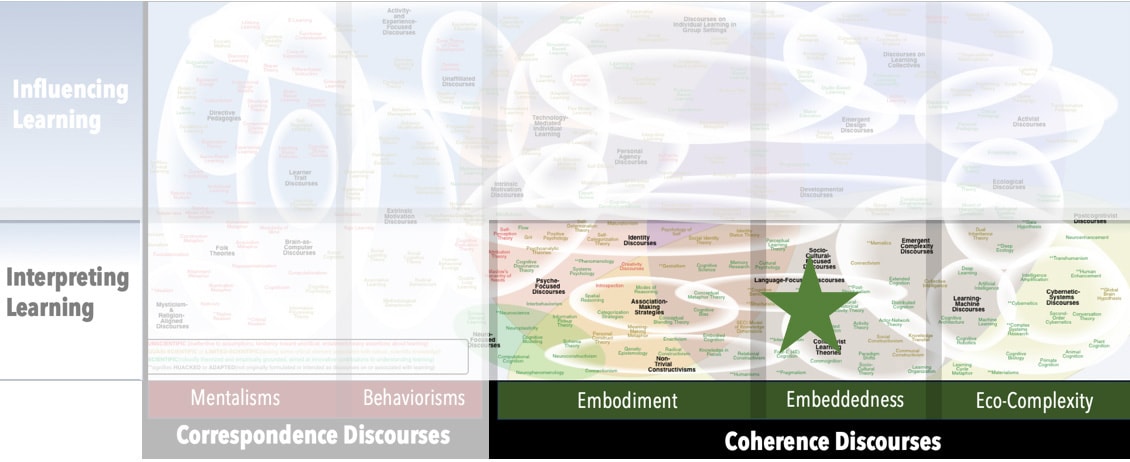
Map Location
Please cite this article as:
Davis, B., & Francis, K. (2026). “Materialisms” in Discourses on Learning in Education. https://learningdiscourses.com.
⇦ Back to Map
⇦ Back to List