
AKA
Science of Memory
Focus
Types of memory and how they’re formed, maintained, activated, and accessedPrincipal Metaphors
A wide range of metaphors are used to describe memory and memories, and those metaphors tend to be affiliated with the grounding metaphors of specific theories of learning. For example, Cognitivism and other Mentalisms often cast memories as “files” metaphor, whereas Enactivism and other Embodiment Discourses regard memories as “living acts.” The following metaphors are common – but not universal – across discourses on memory and memories:- Knowledge is … retained information
- Knowing is … rehearsing information
- Learner is … dynamic memory system (sensory, cranial, individual, social, and cultural)
- Learning is … elaborating memories
- Teaching is … N/A
Originated
early-1900sSynopsis
Often used as a synonym to “learning,” memory is more specific and applies to the ability to recall something learned after a period of time. Memory Science thus looks at multiple memory systems – that vary according to the type of memory, the location of the memory, the extent of conscious control, the manner of maintenance, the span of preservation, and the role in learning. Some relevant categories on the level of the individual include the following:- Sensory Memory (Sensory Register; Sensory Store) – lingering image/tone/feel after a perception happens, operating as a sort of information buffer for Short-Term Memory. Generally, a Sensory Memory lasts less than a second, it cannot be controlled consciously, and it cannot be altered with practice. Types and associated constructs include:
- Echoic Memory (Auditory Sensory Memory) – that aspect of Sensory Memory that deals with auditory stimuli
- Haptic Memory – that aspect of Sensory Memory that deals with touch stimuli
- Iconic Memory – that aspect of Sensory Memory that deals with sight stimuli
- Trace Decay – the waning of a Sensory Memory
- Short-Term Memory (Immediate Memory; Primary Memory) – constrained immediate recall, typically of 7 ± 2 items. Short-Term Memory endures for up to a minute without rehearsal, provided there’s no interference, and it can be improved modestly with practice, and significantly with mnemonic strategies. Associated constructs include:
- Working Memory – One’s capacity to manage and manipulate Short-Term Memory. Hypothesized aspects include:
- Central Executive (Alan Baddeley, Graham Hitch, 1970s) – the attentional control system that directs focus, switches tasks, and coordinates the other memory components
- Episodic Buffer (Alan Baddeley, Graham Hitch, 1980s) – the integrative workspace that binds information from different sources into coherent, time-ordered episodes
- Phonological Loop (Alan Baddeley, Graham Hitch, 1970s) – the subsystem that temporarily stores and rehearses verbal and auditory information (e.g., words, numbers, sounds)
- Visuospatial Sketchpad (Alan Baddeley, Graham Hitch, 1970s) – the aspect of Working Memory responsible for temporarily holding and manipulating visual and spatial information – such as shapes, locations, movement, and mental images
- Magical Number 7 (George Miller, 1950s) – the popular title of the widely accepted (though often disputed) limit of Short-Term Memory of 7 ± 2 items
- FINST Theory (Visual Indexing Theory) (Zenon Pylyshyn, 1980s) – the suggestion that one can consciously attend to (i.e., recognize as discrete and think about) approximately four “indexed” objects in one’s visual field at a time. (“FINST” is a contraction of fingers of instantiation, based on the analogy, “visual indexes are like fingers.”)
- Working Memory – One’s capacity to manage and manipulate Short-Term Memory. Hypothesized aspects include:
- Long-Term Memory (Secondary Memory) – extensive (i.e., limits are immeasurable) and enduring (i.e., potentially lasting an entire life span) recollections. Preservation involves rehearsal, which often entails significant revision – especially over many repetitions (see Repeated Reproduction, below). There are two types:
- Implicit Memory– invoked unconsciously, typically manifest in gestures, skilled action, and habits of interpretation. There are several subcategories, among which are:
- Associational – evident in intuitions and habits of interpretation
- Body Memory – the notion that memory can be distributed across the body. Althought Body Memory is currently considered hypothetical, the notion is commonly invoked in discussions of childhood trauma and physical prowess.
- Muscle Memory (Motor Learning) – type of Procedural Memory, emerging from repeating a motion over time. A Muscle Memory can be performed smoothly and accurately with minimal or no conscious effort.
- Object Memory – the ability to remember objects and their features (e.g., color, size, texture, positioning). Most tests of Object Memory involve quick exposures to many items, and subjects call typically recall about four items and about four qualities of each.
- Priming – evident in immediate preferential (often biased and/or visceral) responses
- Procedural Memory – evident in skilled performance
- Spatial Memory – the form of memory associated with remembering locations – including orientations in space, the locations of objects, and navigating to preselected locations (Note: Spatial Memory should not be confused with Visual Memory, under Representationalism.)
- Explicit Memory (Declarative Memory) – the conscious recollection of facts, concepts, and past experiences. There are two types, each with multiple subtypes:
- Episodic Memory (Autobiographical Memory; Event Memory) – retention of specific personal experiences. Subcategories include:
- Emotional Memory – the ability to recall Episodic Memories tethered to experiences (or aspects of experiences) that evoked emotional responses
- Semantic Memory (Semantic Knowledge) – meaningful retention of facts and concepts. Subcategories include:
- Fact Learning – the process of established a “fact” (a discrete piece of information) in long-term memory so that it can be recalled later
- Episodic Memory (Autobiographical Memory; Event Memory) – retention of specific personal experiences. Subcategories include:
- Additional constructs associated with Long-Term Memory include:
- Engram – a theoretical construct describing how memories might be maintained in the brain, suggesting that each memory comprises an Engram – a unique network of neurons that are distributed across several brain regions
- Permastore (Harry Bahrick, 1970s) – Long-Term Memory associated with extensive learning or training, whether experienced as Implicit Memory or Explicit Memory
- Propositional Network – a model of Long-Term Memory based on the metaphor of a network, in which memories are seen to be organized as interconnected propositions
- Implicit Memory– invoked unconsciously, typically manifest in gestures, skilled action, and habits of interpretation. There are several subcategories, among which are:
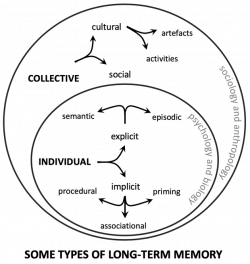 Humans also use Collective Memory (Group Memory), relying on one another and their material worlds to retain memories and maintain collective social identities. Some examples of these Collective Memory include the following:
- Social Memory – The collected knowledge and shared identifications of circles of friends, teams, organizations, professions, and other social collectives is typically distributed among members – so the social system is the unit of memory.
- Cultural Memory – Most human knowledge is actually left out in the world. Two major means of preserving this knowledge are the following:
- Activities – Language, mythologies, ethics, customs, and so on are all means of preserving knowledge. Each can be seen as a vast repository of accumulated insight and wisdom.
- Artefacts – The most familiar external memory systems involve writing and electronic data storage, but almost all human-made artefacts serve or contribute to a memory function.
- Dual-Store Model of Memory (Dual Memory Model) (William James, 1870s) – any model of memory that posits two distinct memory systems: one for recall of transient details in the immediate moment and one for resilient, long-term recollections
- Repeated Reproduction (Bartlett Technique; Bartlett Tradition; Successive Reproduction) (Frederic C. Bartlett, 1930s) – a technique that demonstrates that a memory transforms if one repeatedly recalls over time actually – usually through a gradual integration of details or perspectives that are unrelated to the original memory but meaningful to the one remembering. The method supports:
- Constructive Memory – the suggestion that memory formation is an active process of building from existing knowledge, experiences, expectations, and emotions rather than a passive process of storing information
- Reconstructive Memory – the suggestion that memory retrieval involves rebuilding past events or experiences, often filling in gaps with assumptions or schemas – as opposed to “pulling up” stored information
- Two-Stage Memory Theory (1940s) – a model that describes the creation of permanent memories in terms of a transition from Short-Term Memory to Long-Term Memory, usually involving rehearsal of some sort
- Acid Bath Theory (Michael Posner, A.F. Konick, 1960s) – a descriptive theory that draws an analogy between losing track of a short-term memories and immersing an object in acid, where the two critical determinants are the number of items in memory (analogous to the quantity of acid) and the similarity of those items (analogous to the concentration of the acid)
- Multistore Model of Memory (Atkinson–Shiffrin Model; Modal Model; Storage-and-Transfer Model) (Richard Atkinson & Richard Shiffrin, 1960s) – Although it has been heavily criticized, the Atkinson–Shiffrin Model anticipated many insights of contemporary Memory Science in its assertion that memory comprises three stores: Sensory Memory, Short-Term Memory, and Long-Term Memory. The model proposes that memories are transferred to Short-Term Memory are encoded as sound, and those transferred to Long-Term Memoryare encoded as meaning.
- Levels of Processing (Depth of Processing) (F. Craik, R. Lockhart, 1970s) – Rather than distinguishing types of memory in terms of stages, durations, and capacities, Levels of Processing posited that sensory/information stimuli can activate multiple memory levels simultaneously. Generally speaking, the more meaningful or impactful the stimuli, the more levels that can be activated – and, hence, the more enduring and reliable the resulting memories.
- Tulving’s Model (Endel Tulving, 1970s) – Tulving proposed that there were two types of Long-Term Memory – Episodic Memory and Semantic Memory, which he described more-or-less as above. Later, he added Procedural Memory (also, very much as described above), and proposed a sequence of development that started with Procedural Memory in infancy, followed by Semantic Memory, and finally Episodic Memory.
- Conjoint Retention (Raymond Kulhavy, 1980s) – the hypothesis that memories with both verbal and visual-spatial aspects are stored in ways that allow them to be recalled using either or both formats
- Network-Memory Model (Neural Network Model of Information Retrieval) (various, 1980s) – a conception of Long-Term Memory based on the structure of a decentralized network. The strengths of individual memories and of associations among memories are posited to be affected by recency, repetition, and proximity.
- Parallel Distributed Processing (PDP) Model of Memory (D.E. Rumelhard, 1980s) – Unlike other popular models, PDP doesn’t focus on different types of memory. Rather, it frames memory in terms of brain activity, proposing that memory can be understood as activation flows through neuronal networks that are parallel (i.e., multiple processes occur simultaneously) and distributed (i.e., they happen in multiple locations).
- Cognitive Array Model (Array Model) (William Kaye Estes, 1990s) – Memory is organized in arrays of classifications and categorizations that one encounters in one’s environment. These arrays are organized according to principles of utility; their role is to enable one’s actions in the world.
- Complementary Learning Systems (J.L. McClelland, 1990s) – a theory of how the brain simultaneously consolidates memories of distinct experiences while it develops non-specific, generalized senses of the structures of experiences. Complementary Learning Systems posits that the two distinct, but interactive and complementary parts of the brain are responsible – respectively, the hippocampus and the neocortex
- Act-In Theory (Activation–Integration Theory) (R. Versace, 2010s) – a memory model aligned with Embodiment Discourses and Embeddedness Discourses that associates situated, bodily activity with brain-based dynamics. Act-In Theory asserts that memory traces integrate both immediate and previous sensory, motor, emotional, situational, and relational aspects of experience, and so are distributed across multiple neuronal systems – which is why the retrieval of memories are enabled by actions and circumstances that are similar to those of the original experience
- Adaptive Forgetting – the idea that forgetting can be useful, as the mind reduces access to information that is outdated, distracting, or competing with what matters now. That is, Adaptive Forgetting isn’t memory failure; it’s a process for keeping thought and action efficient.
- Amnesia – from the Ancient Greek ἀμνησία “without memory,” the loss of memories. Types include:
- Anterograde Amnesia – inability to form new memories
- Retrograde Amnesia – inability to recall old memories
- Decay Theory (Trace Decay Theory) (Edward Thorndike, 1914) – the proposal the memory traces weaken and fade over time due to the natural process of disuse. Decay Theory is primarily relevant to Short-Term Memory, where information is quickly lost if not transferred to Long-Term Memory. Associated notions include:
- Forgetting Curve (Ebbinghaus’s Curve of Retention) (Hermann Ebbinghaus, 1890s) is visual representation that is purported to show how a memory weakens over time when it is not practiced or rehearsed. That weakening is typically characterized as an exponential decay (and often described in terms of half-life – i.e., the time required to reduce to half of the current strength).

- Interference Theory (Retrieval Interference) (various, 1940s) – the study of factors that frustrate learning and limit memory, such as prior learnings, inappropriate associations to familiar situations, accidental conflations, and so on. Associated constructs include:
- Order Effect (Herman Ebbinghaus, 1880s) – the tendency for judgments, memories, or responses to be influenced by the sequence in which information is presented
- Retroactive Interference (Retroactive Inhibition) – when new learning makes it more difficult to recall or act on previous learning
- Accelerated Forgetting (Accelerated Long-Term Forgetting) – the phenomenon whereby one is able to recall details with normal precision after 30 minutes, but unable to recall with normal precision after longer delays. Accelerated Forgetting is most often attributed to Retroactive Interference.
- Displacement Theory (Donald Broadbent, 1950s) – the suggestion that, when Short-TermMemory is full, new information can displace or push out old information. The oldest information in short-term memory is typically displaced first, similar to a conveyor belt where items are pushed off as new ones are added.
- Proactive Interference (Proactive Inhibition) – when old learning interferes with new learning. Associated constructs include:
- Fan Effect (John Anderson, 1970s) – an increase in the time needed to recall relevant details of a concept, owing to an increase in the number of associations has for that concept
- Response Competition – the Behaviorisms version of Interference Theory, expressed in terms of competing “conditioned responses” rather than a range of personal circumstances
- Motivated Forgetting (Active Forgetting) – the suggestion that people may actively forget memories, especially unpleasant or traumatic ones. This process is crucial for maintaining cognitive flexibility and removing irrelevant information. It involves two types of forgetting:
- Repression – unconscious of unwanted experiences or impulses from conscious awareness (See Psychoanalytic Theories.)
- Suppression (Directed Forgetting; Intentional Forgetting) – the cognitive process of deliberately suppressing or weakening unwanted memories. Specific types include:
- Think, No-Think (Michael Anderson, Collin Green, 2000s) – an experimental method in cognitive psychology and neuroscience designed to study memory suppression – specifically, how people can deliberately suppress unwanted memories. The method has shown that repeated suppression can impair later recall.
- Unlearning– the deliberate process of replacing obsolete and/or inappropriate habits or skills with others that are more fitted to current circumstances
- Reconsolidation (Karim Nader, 2000s) – the distorting and rewriting of a memory each time it is recalled. Recalling a memory temporarily destabilizes it, during which new information, emotions, or biases can be integrated into the memory.
- Remembered Present (Gerald Edelman, 1980s) – the neural reconstruction of immediate experience from memory and perception – meaning one’s conscious awareness is always a biologically mediated re-presentation of the recent past
- Retrieval Failure Theory (Cue-Dependent Forgetting) (Endel Tulving, 1970s) – the suggestion that forgetting occurs not because the memory trace is gone, but because appropriate retrieval cues are missing. That is, some Long-Term Memory can't be accessed because the right cues are not present to trigger recall.
- Block (Mental Block) – a sudden awareness that one is unable to perform an expected competency, such as expressing a thought. Closely associated constructs include:
- Feeling of Knowing (FOK) – that confident sense of knowing something that cannot be immediately recalled. Closely associated constructs include:
- Fringe Consciousness – aspects of experience that were never the focus of consciousness, but that nonetheless are typically reported with high levels of precision and confidence
- Retrieval Block – a temporary inability to summon a detail from memory, often associated with a sensation of being blocked
- Tip-of-the-Tongue Phenomenon (TOT Phenomenon) – that frustrating sensation of being unable to summon a familiar name, word, or other detail
- Digital Amnesia (Kaspersky Lab, 2020s) – an amplified reliance on digital devices, associated with loss of ability to remember that information. Reasons for the decline in memory may include interruptions to processes of long-term consolidation (e.g., distractions, interruption sleep) and diminished need to exercise memory (e.g., using devices to retain information and manage prompts). Related prior constructs include:
- Al Brain Fry (2020s) – a folk label for over-offloading thinking to Al – that is, a perceived cognitive dulling that some people report after heavy reliance on generative Al tools
- Brain Rot (1980s) – originally coined to label the adverse effects of excessive television consumption, a term often used to describe a state of mental dullness or decline associated with overconsumption of mindless online content
- Digital Hangover (various, 2000s) – the lingering fatigue, brain fog, eye strain, mood decline, and productivity loss caused by excessive or late-night digital use, especially from screens, social media, or streaming disrupting sleep and mental balance
- Gen Z Stare (TikTok, 2000s) – a blank, deadpan look – direct eye contact with no expression – that is often attributed to social skills stunted by excessive screen time and pandemic lockdowns
- Google Effect (Betsy Sparrow, Jenny Liu, Daniel Wegner, 2010s) – retaining fewer facts but recalling where and how information can be retrieved. This transformation in how young people remember information is attributed to ready-and-reliable access to the Internet.
-
Eidetic Memory – the ability to recall visual details of an object or image in fine-grained detail for some minutes after it has been removed from view, typically experienced as continuing to “see” it. Eidetic Memory is more common in young children and rarely found among adults. Associated constructs include:
-
Photographic Memory – reputedly, the ability to recall precise visual details of a scene indefinitely after it is no longer available. No case of true Photographic Memory has ever been documented.
-
- Elaboration Rehearsal (F. Craik, R. Lockhart, 1970s) – transferring information to Long-Term Memory through putting it into context of other knowledge or previous experience
- Elaborative Interrogation (Tim Seifert, 2010s) is a method intended to enhance memory by asking the learner not just to remember a fact, but to explain that fact – in the process, generating associations to prior learnings.
- Fact Memory – as the name suggests, memory for facts (i.e., dissociated from origins or contexts of learning) (Contrast: Source Memory)
- Flashbulb Memory (Roger Brown, James Kulik, 1970s) – a memory with extreme clarity, owing to the consequential or arousing nature of the event remembered
- Generation Effect – information will be remembered better if the learner has generated it (as opposed to being told or reading it)
-
Hypermnesia (P.B. Ballard, 1910s) – the improvement of memory associated with repeated efforts to recall previously learned material
-
Hyperthymesia (Highly Superior Autobiographical Memory; HSAM; Hyperthymestic Syndrome) (James McGaugh, 2000s) – the ability to recall a great number of personal experiences in fine-grained and immediate (“as though it was yesterday”) detail. Hyperthymesia is rare and believed to occur in about 1 in 50–100 million people.
- Imagery Effect – the meaning of a word will be better remembered if the word is associated with an image
- Maintenance Rehearsal (F. Craik, R. Lockhart, 1970s) – keeping the contents of Short-Term Memory active by using rote repetition
- Memory Manipulation – the intentional alteration of how one recalls past events – through psychological pressure, narrative control, and/or technological intervention – to distort, overwrite, or reshape one’s understanding (often to influence behavior or diminish trust in one’s own memory)
- Misattribution of Memory – the misidentification or invention some facet of a memory. Types include:
- Cryptomnesia (Inadvertent Plagiarism; Unconscious Plagiarism) – a type of Implicit Memory (see Memory Science) by which one takes credit for an insight or idea that was actually introduced earlier by someone else. Associated constructs include:
- Social Cryptomnesia – a collective lapse in remembering or recognizing the roots of and reasons for a societal change, such as women’s or minority rights. Such lapses are typically accompanied by forgetting or downplaying the disproportionate suffering and sacrifice of those who led the change.
- False Memory – a memory of something that didn’t actually happen or that happened significantly differently to the recollection. Associated notions include:
- Unconscious Transfer – a creation of a False Memory through the conflation of unrelated memories
- Source-Monitoring Error (Source Confusion; Source Misattribution) – the misidentification of the source of a memory (e.g., believing it was personally witnessed when it was really seen on the news)
- Cryptomnesia (Inadvertent Plagiarism; Unconscious Plagiarism) – a type of Implicit Memory (see Memory Science) by which one takes credit for an insight or idea that was actually introduced earlier by someone else. Associated constructs include:
- Mood-Dependent Memory (Gordon Bower, 1980s) – the observation that long-term memories are more successfully summoned when one is in the same mood as when those memories were formed
- Olfactory Enrichment (Rachel Herz, 1990s) – the deliberate use of scents to stimulate smell in ways that enable memory, leveraging the strong neurological link between olfaction, the limbic system, and enhanced recall, regulation, and engagement
- Overlearning (Hermann Ebbinghaus, 1890s) was originally defined as the number of repetitions needed in order to recall memorized material with 100% accuracy. It is currently more loosely defined in terms of practicing after the point of desired or required proficiency.
- Sharpening – a process of more precisely defining – and, often, exaggerating the details of a memory over time
- Sleep Learning (2010s; not to be confused with Sleep-Learning, below) is an emerging focus within Neuroscience concerned with a range of influences that sleep has on learning – both when awake (e.g., the relationship between rest and recall) and when asleep (e.g., the role of "playback" while dreaming in consolidating memories). Associated discourses include:
- Dream Engineering – the scientific practice of influencing dream content through sensory cues, memory-reactivation techniques, and lucid-dream induction. Used in sleep research and therapy, Dream Engineering supports memory consolidation, nightmare reduction, trauma recovery, and creativity.
- Lucid Dreaming (ancient) – a state in which one becomes aware one is dreaming during REM sleep, often allowing one to consciously influence or control the dream’s content in ways that can shape one’s waking life
- Restoration Theory (Repair and Restoration Theory) (Ian Oswald, 1960s) – the perspective that the purpose of sleep is to revitalize functioning. Specifically, it is asserted that NREM sleep restores physiological systems and REM sleep reinvigorates brain processes.
- Reverse Learning (Crick–Mitchison Theory) (Francis Crick, Graeme Mitchison, 1980s) – a perspective on memory consolidation founded on the assertion that one dreams to forget – that is, to afford the cortex an opportunity to sift through the vast amount of information encountered while awake and to “reverse learn” whatever is unwanted (i.e., wipe out unwanted neural connections)
- Sleep-Learning (Hypnopedia, not to be confused with Sleep Learning, above) refers to strategies aimed as prompting passive learning during sleep – through, for example, external audio input. While ancient and popular, it is neither well understood nor well supported.
- Source Memory – memory both for something one has learned and for the circumstances of that learning (e.g., context, time, associated perceptions and/or emotions) (Contrast: Fact Memory)
- Source Monitoring Framework (Marcia Johnson, 1990s) – a theory explaining how individuals determine the origins of their memories – whether from personal experience, imagination, media, or other. It holds that source judgments are inferential, relying on qualitative features like vividness, emotion, and context. False memories arise when these sources are misattributed. (See Misattribution of Memory, above.)
- Spreading Activation (Allan Collins & Elizabeth Loftus, 1970s) – a hypothetical process by which the activation of one part of the brain’s nested structure (e.g., a neuron, a minicolumn, a macrocolumn, etc.) will increase the likelihood that connected structures will activate, and so on, thus spreading through a tightly connected region of the brain
Commentary
Perhaps the only substantial criticism that might be made on this topic is that humans tend to plod along without much considering the complex dynamics and the varied strategies associated with memory. Within education, the spectrum of opinion on Memory Science is perhaps most strongly represented by the contrast of proponents of Rote Learning and those who frame learning in terms of the Sensemaking Metaphor.Authors and/or Prominent Influences
DiffuseStatus as a Theory of Learning
It would be inappropriate to categorize Memory Science as a theory of learning, but it’s not such a stretch to suggest that any insight into memory is an insight into learning. As such, the information contained in this entry could be construed in terms of learning theory.Status as a Theory of Teaching
Memory Science is clearly not a theory of teaching. However, knowledge of memory systems, their distinct qualities, and their complementary natures could contribute substantially to the theory and practice of teaching.Status as a Scientific Theory
For the most part, popular discussions of memory frame in terms of Folk Theories (e.g., saving, storing, accumulating). As a general topic, then, it is usually not treated scientifically. As a focus of inquiry within Cognitive Science and related domains, however, Memory Science is scientifically theorized and researched.Subdiscourses:
- Accelerated Forgetting (Accelerated Long-Term Forgetting)
- Acid Bath Theory
- Act-In Theory (Activation–Integration Theory)
- Adaptive Forgetting
- Al Brain Fry
- Amnesia
- Anterograde Amnesia
- Block (Mental Block)
- Body Memory
- Brain Rot
- Central Executive
- Cognitive Array Model (Array Model)
- Collective Memory (Group Memory)
- Complementary Learning Systems
- Conjoint Retention
- Constructive Memory
- Cryptomnesia (Inadvertent Plagiarism; Unconscious Plagiarism)
- Cultural Memory
- Decay Theory (Trace-Decay Theory)
- Digital Amnesia
- Digital Hangover
- Dream Engineering
- Dual-Store Model of Memory (Dual Memory Model)
- Echoic Memory (Auditory Sensory Memory)
- Eidetic Memory
- Elaborative Interrogation
- Elaboration Rehearsal
- Emotional Memory
- Engram
- Episodic Buffer
- Episodic Memory (Autobiographical Memory; Event Memory)
- Explicit Memory (or Declarative Memory)
- Fact Learning
- Fact Memory
- False Memory
- Fan Effect
- Feeling of Knowing
- FINST Theory (Visual Indexing Theory)
- Flashbulb Memory
- Forgetting Curve (Ebbinghaus’s Curve of Retention)
- Fringe Consciousness
- Gen Z Stare
- Generation Effect
- Google Effect
- Haptic Memory
- Hypermnesia
- Hyperthymesia (Highly Superior Autobiographical Memory; HSAM; Hyperthymestic Syndrome)
- Iconic Memory
- Imagery Effect
- Implicit Memory
- Interference Theory (Retrieval Interference)
- Levels of Processing (Depth of Processing)
- Long-Term Memory (Secondary Memory)
- Lucid Dreaming
- Magical Number 7
- Maintenance Rehearsal
- Memory Manipulation
- Misattribution of Memory
- Mood-Dependent Memory
- Motivated Forgetting (Active Forgetting)
- Multistore Model of Memory (Atkinson–Shiffrin Model; Modal Model; Storage-and-Transfer Model)
- Muscle Memory (Motor Learning)
- Network-Memory Model (Neural Network Model of Information Retrieval)
- Object Memory
- Olfactory Enrichment
- Order Effect
- Overlearning
- Parallel Distributed Processing (PDP) Model of Memory
- Permastore
- Phonological Loop
- Photographic Memory
- Proactive Interference (Proactive Inhibition)
- Procedural Memory
- Propositional Network
- Reconsolidation
- Reconstructive Memory
- Remembered Present
- Repeated Reproduction (Bartlett Technique; Bartlett Tradition; Successive Reproduction)
- Response Competition
- Restoration Theory (Repair and Restoration Theory)
- Retrieval Block
- Retrieval Failure Theory (Cue-Dependent Forgetting)
- Retroactive Interference
- Retrograde Amnesia
- Reverse Learning (Crick–Mitchison Theory)
- Semantic Memory (Semantic Knowledge)
- Sensory Memory (Sensory Register; Sensory Store)
- Sharpening
- Short-Term Memory (Immediate Memory; Primary Memory)
- Sleep Learning
- Sleep-Learning (Hypnopedia)
- Social Cryptomnesia
- Social Memory
- Source Memory
- Source-Monitoring Error (Source Confusion; Source Misattribution)
- Source Monitoring Framework
- Spatial Memory
- Spreading Activation
- Suppression (Directed Forgetting; Intentional Forgetting)
- Think, No-Think
- Tip-of-the-Tongue Phenomenon
- Trace Decay
- Tulving’s Model
- Two-Stage Memory Theory
- Unconscious Transfer
- Unintentional Forgetting (Retrieval-Based Forgetting; Retrieval-Induced Forgetting)
- Unlearning
- Visuospatial Sketchpad
- Working Memory (Active Memory)
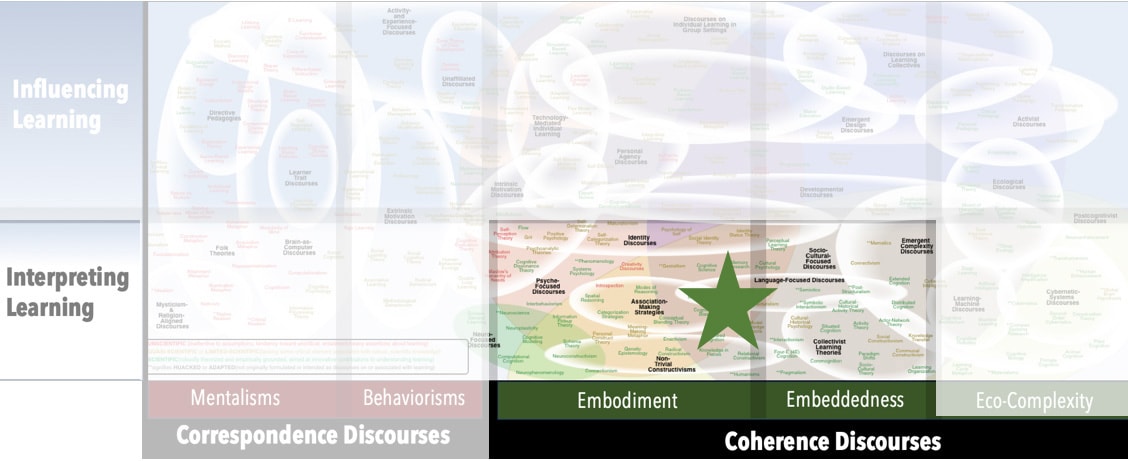
Map Location
Please cite this article as:
Davis, B., & Francis, K. (2026). “Memory Science” in Discourses on Learning in Education. https://learningdiscourses.com.
⇦ Back to Map
⇦ Back to List