
Focus
Habits of interpretation and patters of behavior in an organizationPrincipal Metaphors
- Knowledge is … the culture of an organization
- Knowing is … current activity of an organization
- Learner is … an organization
- Learning is … changes in practice that have an effect of collective dynamics
- Teaching is … N/A
Originated
1950sSynopsis
Organizational Culture refers to the “personality” of an organization – that is, its distinguishing habits of thinking and acting, as manifest in communications, customs, and priorities. Associated discourses include:- Attraction–Selection–Attrition Model (Benjamin Schneider, 1980s) – the suggestion that one is drawn to an Organizational Culture that is congruent with one’s own personality – which, over time, contributes to the homogenization of the organization
- Organizational Culture Analysis (Edgar Schein, 1970s) – a formal assessment following a prescribed format, involving all members of an organization, of Organizational Culture in order to identify aspects that enable and aspects that hinder the organization
- Competing Values Framework (CVF) (Robert Quinn, Fohn Rohrbaugh, 1980s) – a model of organizational culture and effectiveness that explains how organizations balance fundamentally competing priorities. CVF is built on two orthogonal tensions – “Flexibility & Discretion” versus “Stability & Control” – generating four culture types:
- Adhocracy Culture (Robert Quinn, Fohn Rohrbaugh, 1980s) – a culture prioritizes flexibility, innovation, and experimentation. Organizations are dynamic and entrepreneurial, encouraging risk-taking and creativity. Effectiveness is judged by adaptability, growth, and the ability to generate new ideas or opportunities.
- Clan Culture (Robert Quinn, Fohn Rohrbaugh, 1980s) – a culture that emphasizes collaboration, trust, and cohesion. Organizations operate like communities, valuing mentoring, participation, and shared commitment. Effectiveness is associated with morale, loyalty, and people development.
- Hierarchy Culture (Robert Quinn, Fohn Rohrbaugh, 1980s) – a culture values stability, control, and formal structure. Organizations rely on rules, procedures, and clear authority. Effectiveness is defined by efficiency, reliability, consistency, and smooth coordination.
- Market Culture (Robert Quinn, Fohn Rohrbaugh, 1980s) – a culture focuses on competition, results, and external positioning. Organizations emphasize performance, targets, and winning in the marketplace. Effectiveness is measured through productivity, achievement, and goal attainment.
- Denison’s Organizational Culture Model (Daniel Denison, 1990s) – a model that links Organizational Culture directly to performance and effectiveness by identifying cultural traits that balance internal–external focus and flexibility–stability: Involvement (employee empowerment, team orientation, capability development), Consistency (core values, agreement, coordination), Adaptability (responsiveness to the external environment, learning), Mission (purpose, strategic direction, and long-term goals)
- 4 Stages of Psychological Safety (Timothy Clark, 2020s) – a model addressing Organizational Culture, leadership, team performance, inclusion, and innovation – comprising:
-
- Inclusion safety — feeling accepted and valued as a member of the group
- Learner safety — feeling safe to ask questions, learn, and make mistakes
- Contributor safety — feeling safe to use your skills, share ideas, and take responsibility
- Challenger safety — feeling safe to question decisions, raise concerns, and suggest change
- Handy’s Model of Organizational Culture (Charles Handy, 1970s) – a classification of r ideal-type cultures, based on how power, roles, tasks, and people are organized:
- Person Culture (Charles Handy, 1970s) – a culture in which authority organization exists to support autonomous individuals. Professional independence is central, coordination is minimal, and collective direction is weak unless members’ interests align.
- Power Culture (Charles Handy, 1970s) – a culture in which authority concentrates in a small core and influence flows through personal relationships rather than formal rules. Decisions are fast, political, and leader-dependent, with success tied to proximity to power.
- Role Culture (Charles Handy, 1970s) – a culture in which authority derives from defined positions and procedures. Stability, predictability, and fairness are prioritized, but adaptability suffers as coordination depends on rules rather than judgment.
- Task Culture (Charles Handy, 1970s) – a culture in which authority follows expertise and problem requirements. Temporary teams form to solve problems, emphasizing collaboration and results, with flexibility gained at the cost of clear hierarchy.
- Hofstede’s Cultural Dimensions Theory (Geert Hofstede, 1970s) – a framework of six dimensions developed to compare Organizational Cultures based on shared values that shape behavior in organizations and institutions: Power Distance (the extent to which unequal distribution of power is accepted as normal), Individualism vs. Collectivism (prioritizing of individual autonomy versus group loyalty), Masculinity vs. Femininity (valuing of competition, achievement, and assertiveness versus care, cooperation, and quality of life), Uncertainty Avoidance (toleration of ambiguity and uncertainty), Long-Term vs. Short-Term Orientation (emphasizing perseverance, adaptation, and future rewards versus tradition, stability, and immediate outcomes), Indulgence vs. Restraint (the degree to which gratification of desires is permitted)
- Schein’s Three-Level Model Of Organizational Culture (Edgar Schein, 1980s) – an analysis of Organizational Culture according to three “layers,” ranging from “Artifacts” (visible manifestations – structures, rituals, language, dress, stories, and observable behaviors), through “Espoused Values” (stated beliefs, strategies, goals, and philosophies), to “Basic Underlying Assumptions (deep, unconscious, taken-for-granted beliefs about reality, human nature, relationships, and truth)
Commentary
Organizational Culture began as a descriptive construct, and so was initially inattentive to the natures of adaptive change. As a result, the discourse can seem rather naïve around matters of collective learning and systemic transformation. Additionally, the perspective is not entirely clear on (or, depending on the version, consistent about) who or what is aware of the organization’s knowing.Authors and/or Prominent Influences
Elliott JaquesStatus as a Theory of Learning
Organizational Culture is not a theory of learning, but it is often invoked to characterize organizational transformation.Status as a Theory of Teaching
Organizational Culture is not a theory of teaching, but it is typically utilized in efforts to interpret and affect the functioning of an organization. In a sense, then, Organizational Culture is theory of organizational teaching – that is, it serves to inform strategies intended to enable and tools used to measure an organization’s adaptation over time.Status as a Scientific Theory
Organizational Culture does not include consideration or critique of its own assumptions about the nature of learning or the metaphors used to characterize learning. Put differently, Organizational Culture opts for operational definition of learning (i.e., one stated in measurable terms) rather than a well-theorized account of the complex dynamics of learning. Consequently, it does not meet our criteria for a scientific theory.Subdiscourses:
- Adhocracy Culture
- Attraction–Selection–Attrition Model
- Clan Culture
- Competing Values Framework (CVF)
- Denison’s Organizational Culture Model
- 4 Stages of Psychological Safety
- Handy’s Model of Organizational Culture
- Hierarchy Culture
- Hofstede’s Cultural Dimensions Theory
- Market Culture
- Organizational Culture
- Organizational Culture Analysis
- Person Culture
- Power Culture
- Role Culture
- Schein’s Three-Level Model Of Organizational Culture
- Task Culture
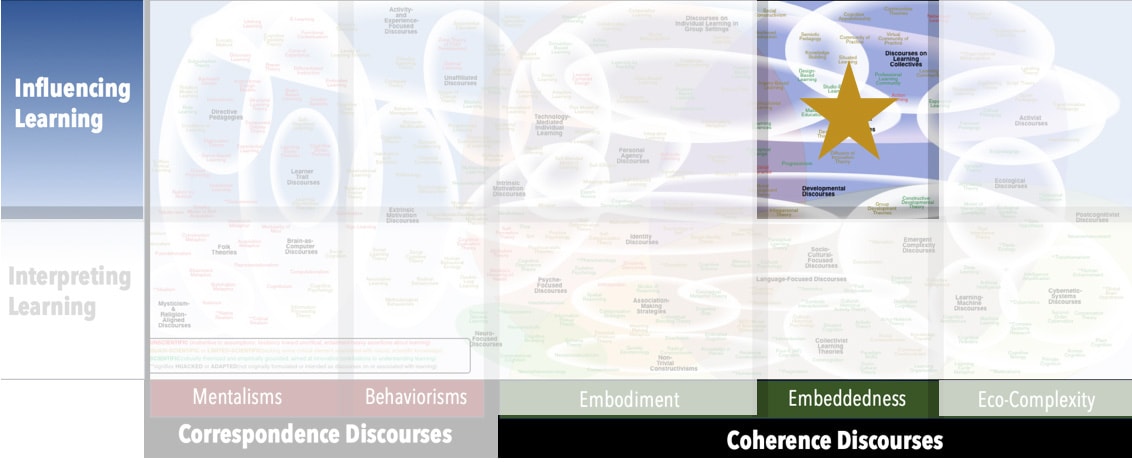
Map Location
Please cite this article as:
Davis, B., & Francis, K. (2026). “Organizational Culture” in Discourses on Learning in Education. https://learningdiscourses.com.
⇦ Back to Map
⇦ Back to List