
AKA
Gnosophysiology
Focus
Context-triggered transformations of plantsPrincipal Metaphors
- Knowledge is … the sum of processes involved with living
- Knowing is … being (maintaining coherence; surviving)
- Learner is … a plant
- Learning is … survival-enhancing action
- Teaching is … N/A
Originated
late-1800sSynopsis
Plant Cognition is a research domain concerned with experimentally testing plants’ capabilities to perceive, respond to, and learn from interactions and other experiences/stimuli. Some sub-interests include root interactions, plant spatial awareness, plant social systems, plants learning to anticipate through Classical Conditioning, plant decision-making triggered by environmental stresses, and possible similarities between plant structures and animal nervous systems. Associated discourses and constructs include:- Basal Cognition (Pamela Lyon, 2020s) – the fundamental, minimal cognitive processes that exist at the cellular level in all living things, founded on the premise that cognition does not require a brain or nervous system
- Extended Cognition in Plants (André Geremia Parise, Monica Gagliano, Gustavo Maia Souza, 2020s) – an adaptation of Extended Cognition to the more-than-human world, concerned with the role of mediation of root systems and Mycorrhizal Networks in enabling cognitive abilities of communities of plants
- Mycorrhizal Network (Common Mycorrhizal Network) – an underground network of mycorrhizal fungi found among roots of plant communities
- Plant Intelligence (various, 2010s) – any manner of physical response or adaptation that is beneficial to a specific plant, an ecosystem of plants, or a species of plant
- Plant Perception (various, 1990s) – the ability of and means by which plants sense and respond to stimuli in their environments. Plant Perception involves both morphology (form/structure) and physiology (dynamics/function) of plants.
Commentary
As might be anticipated, most commentary on and criticism of Plant Cognition have two main foci: (1) entrenched conceptual boundaries between animals and plants, and (2) entrenched brain-based definitions of cognition. Regarding the former, in a tone that is eerily reminiscent of debates on animal cognition a few decades ago and debates on human cognition a century ago, many are uncomfortable with the suggestion that plant activity might be better framed in terms of Darwinian dynamics than Newtonian mechanics. That is, talking about how plants react (i.e., drawing on physics) is fine, but assertions of choice, communication, and decision-making are bridges too far. Regarding the latter, some regard the observation that plants don’t have brains as clear and sufficient evidence that principles of cognition cannot be applied. Subdiscourses include:- Brain Chauvinism (Kevin Warwick; 2010s) – the tendency to reject notions of plant intelligence and consciousness on the basis of a conviction that such phenomena rely on a human-like central nervous system
- Plant Blindness (James Wandersee, Elizabeth Schussler, 1990s) – in ecological terms, an inability to recognize the place and importance of plants for life and well-being; in cognitive terms, a failure to realize that plant have/are cognitive systems
- Absolute Idealism (Georg Wilhelm Friedrich Hegel, 1810s) – the perspective that all of reality is a manifestation of an absolute spirit or mind
- Animism (ancient) – the belief that nonliving aspects of the more-than-human world, such as inanimate objects and natural phenomena, have qualities of living forms, such as emotions and goals
- Hylozoism (ancient) – the perspective that all physical forms are alive or, on some level, animate
- Mind Stuff (William Clifford, 1870s) – the suggestion that all matter has consciousness. More descriptively, Mind Stuff is asserted to be the substance that constitutes reality, externally manifested as matter and internally manifestated as mind.
- Panpsychism (Psychism) (ancient) – the conviction, whether informal belief or formal philosophy, that all of reality is minded – that is either part of or infused with mind-like qualities, which some commentators argue include sentience, subjective experience, intelligence, and/or intention. Associated discourses include:
- Micropsychism – the view that all fundamental physical entities possess minimal forms of consciousness, and complex minds arise from combinations of these micro-experiences. Micropsychism is a variant of Panpsychism, focused on consciousness at the smallest physical scale.
- Neuroelectrical Panpsychism (James E. Jones, 2013) – the proposal that consciousness arises from and is identical to the brain’s neuroelectrical activity – which entails that consciousness is an intrinsic property of electrical fields themselves
- Pancognitivism (David Ray Griffin, 1990s)– the assertion that, at a fundamental level, thought is present everywhere
- Panexperientialism (Alfred North Whitehead, 1920s) – a form of Panpsychism that holds that all entities in the universe possess some degree of experience or subjectivity, even if not conscious awareness. That is, Panexperientialism suggests that experience is a universal feature of reality, but cognition and self-awareness emerge only in complex systems like animals and humans. Subdiscourses include:
- Panexperientialist Physicalism (David Ray Griffin, 1990s) – the view that matter itself is experiential – that is, all physical entities have some degree of experience. The perspective unites mind and matter within a single, process-based physical world.
- Process Paenexperientialism (Alfred North Whitehead, 1910s) – a blend of Processism (under Coherence Discourses) and Panexperientialism, holding that reality is made up of experiential processes, not static things. Every entity—atoms, cells, people—is a moment of experience in continual becoming.
- Quantum Information-Based Panpsychism (Federico Faggin, 2020s) – the suggestion that consciousness is intrinsic to quantum information. Every quantum system possesses a primitive form of awareness, and complex conscious experience arises from integrated informational structures within the quantum fabric of reality. (See Quantum Cognition.)
- Technological Approach to Mind Everywhere (TAME) (Michael Levin, 2020s) – the view that mind and cognition are emergent control processes found across all living systems. TAME treats intelligence as a scale-free property of goal-directed information processing, not limited to brains, enabling synthetic and biological unification of cognition.
- Spirituality – a variously interpreted notion that is most often understood in terms of belief in or attendance to layers or aspects of reality that influence or direct events in the world. Such aspects or forces are deemed either immanent in all material forms or incorporeal.
- Vegetative Soul (Nutritive Soul) (Aristotle, 300s BCE) – a soul able to growth and reproduce, but unable to perceive or think (compare: Sensitive Soul, under Animal Cognition; Rational Soul under Primate Cognition)
Authors and/or Prominent Influences
DiffuseStatus as a Theory of Learning
Plant Cognition is a theory of learning – and one that is proving a useful device for compelling commentators to reveal their deep-seated (usually dualism-based) assumptions and beliefs about learning.Status as a Theory of Teaching
Plant Cognition is not a theory of teaching.Status as a Scientific Theory
In spite of the reservations of its many detractors, Plant Cognition is a scientific theory – in part because proponents (unlike many detractors) are explicit about assumptions, metaphors, and definitions surrounding learning and cognition. As well, Plant Cognition has a substantial and rapidly growing evidence base.Subdiscourses:
- Absolute Idealism
- Animism
- Basal Cognition
- Brain Chauvinism
- Extended Cognition in Plants
- Hylozoism
- Micropsychism
- Mind Stuff
- Mycorrhizal Network (Common Mycorrhizal Network)
- Neuroelectrical Panpsychism
- Pancognitivism
- Panexperientialist Physicalism
- Panexperientialism
- Panpsychism (Psychism)
- Plant Intelligence
- Plant Perception
- Plant Blindness
- Process Paenexperientialism
- Technological Approach to Mind Everywhere (TAME)
- Vegetative Soul (Nutritive Soul)
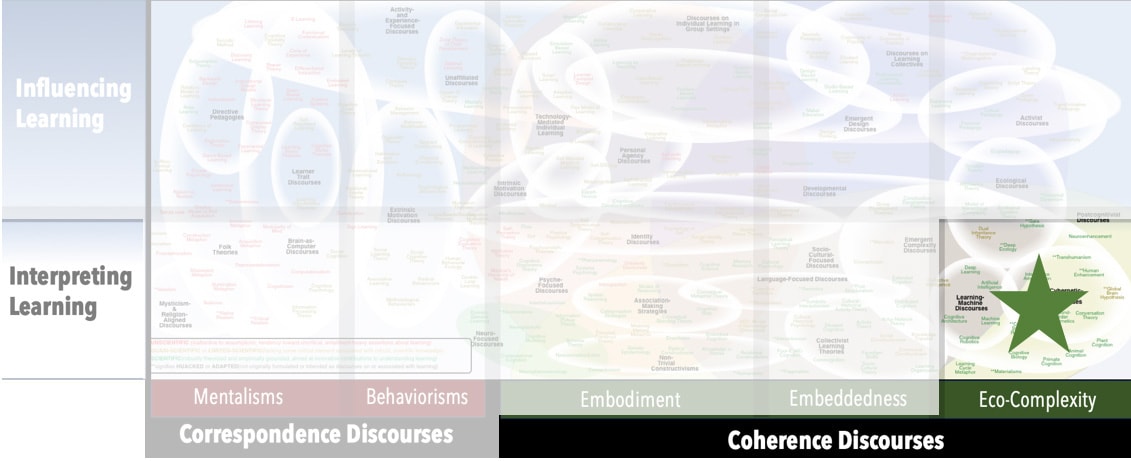
Map Location
Please cite this article as:
Davis, B., & Francis, K. (2026). “Plant Cognition” in Discourses on Learning in Education. https://learningdiscourses.com.
⇦ Back to Map
⇦ Back to List