
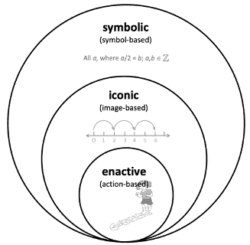
 Three-Stage Learning Model (Jerome Bruner, 1966) – while not discipline-specific, this model looks at the intersection of types of experience and means of representation in its suggestion that humans have three principal modes of interpreting experience. In the first mode (enactive), the learner is engaged in movement and manipulation; in the second (iconic), the learner deals with images that represent active situations and manipulatable objects; in the third (symbolic), the learner operates mainly on symbols. While Bruner associated the prevalence of these modes with age ranges, he also acknowledged that even sophisticated experts routinely engage all modes when encountering novel problems.
-
- Enactive Level: learner physically manipulates materials
- Iconic Level: learner deals with images that represented manipulable objects
- Symbolic Level: learner manipulates symbols
Please cite this article as:
Davis, B., & Francis, K. (2020). “Three-Stage Learning Model” in Discourses on Learning in Education. https://learningdiscourses.com.
⇦ Back to Map
⇦ Back to List