
AKA
Developmental Psychology
Lifespan Psychology
Stage Theories
Structural Stages Theories
Focus
Qualitative shifts in modes of cognitionPrincipal Metaphors
- Knowledge is … the range of developmental possibility
- Knowing is … stage-specific acting
- Learner is … a transforming individual (sometimes, an individual-in-context; rarely, a collective)
- Learning is … developing (often: movement along an anticipated trajectory)
- Teaching is … prompting, triggering, supporting
Originated
1940sSynopsis
Within Developmental Discourses, learning is understood as a recursively elaborative process rather than a linear accumulative one. Most Developmental Discourses focus on how learners’ key habits of perception and interpretation – that is, their strategies and preferences for construing and reconstruing their webs of understanding – change amid predictable sequences of biological, psychological, and emotional transformation. Importantly, development is not seen as unidirectional or steadily paced across these discourses. In this regard, relevant constructs include:- Child Development – the sequential behavioral, cognitive, and physiological changes of individuals from birth through adolescence
- Formation – the ongoing process through which individuals, groups, ideas, identities, and practices take shape and evolve. Formation arises through the dynamic interplay of biological, cognitive, emotional, social, cultural, and environmental influences that shape how people understand, engage with, and participate in the world.
- Growth – in principle, any sequence of changes that contributes to expanded psychological and/or physical possibilities for an agent. That said, among Developmental Discourses, “growth” is often (but not always) treated as a synonym for “development” – and, by consequence, it is often interpreted to stop when the agent reaches “maturity.”
- Liminality (Arnold van Gennep, 1910s) – the in-between stage of a rite of passage, when participants are “betwixt and between” social roles. In Liminality, normal structures and hierarchies are suspended, identity is fluid, and transformation is possible.
- Maturational Lag – slowness in some aspect(s) of physical development (relative to agements), typically with consequences for cognition and behavior
- Multistage Theory – a descriptive category that includes any model or theory that is framed in terms of movement through or across multiple, well-defined levels or stages
- Retrogression – an inappropriate reactivation of behaviors, attitudes, or thoughts associated with an earlier stage of development, typically triggered by a stressful and/or unfamiliar circumstance (Compare Regression, under Psychoanalytic Theories.)
- Rousseau’s Theory of Development (Natural Development; Natural Education) (Jean-Jacques Rousseau, 1760s) – an educational philosophy holding that learning should be aligned with the natural course of human development rather than imposed prematurely by society or formal instruction. Rousseau believed that development unfolds according to an intrinsic natural order – from sensory experience, to practical learning, to reason, morality, and social responsibility – and that education should support rather than distort that process.
- Kierkegaard’s Model of Growth (Søren Kieregaard, 1840s) – a description of human development as a movement through three stages, each involving deeper self-awareness, responsibility, and authenticity: Aesthetic Stage (oriented toward pleasure, novelty, and immediate experience); Ethical Stage (characterized by commitment and moral choice); Religious Stage (marked by faith, inwardness, and engagement with uncertainty and transcendence)
- Circular Reaction (William Mark Baldwin, 1890s) – a developmental process in which repeated actions generate feedback, variation, and refinement, allowing infants to consolidate new forms of coordination
- Genetic Logic (William Mark Baldwin, 1890s) – an account of how thought, judgment, and reasoning develop over time through increasingly differentiated forms of mental coordination
- Baldwin Effect (Organic Evolution; Organic Selection) (William Mark Baldwin, 1890s) – the proposal that learned accommodations can shape evolutionary pathways when natural selection favors organisms able to acquire and stabilize those adaptive behaviours
- Early Childhood Education (Early Years Education; Early Experience) – the Formal, Non-Formal, and Informal Learning (see In-/Non-Formal Learning) experiences of a child from birth to the start of schooling, at about age 5
- Hurried Child (Hurried Child Syndrome) (David Elkind, 1980s) – stress-linked behaviors arising from expecting too much of children too soon – often in the context of academic performance, but also in physical, social, and emotional matters
-
Infantile Amnesia (long known, but first theorized by Sigmund Freud, 1900s) – the phenomenon where adults are unable to recall memories from the early years of life, typically before ages 3 or 4. While people may retain some fragments (especially emotional or procedural), detailed autobiographical memory from infancy is generally absent.
- Lifespan Development Theory (Paul Baltes, 1970s) – a perspective on human development as a lifelong process that’s marked by continuous growth and change from birth to old age. The theory emphasizes the dynamic interplay of biological, psychological, and social factors, framing development as multidimensional, multidirectional, and influenced by historical and cultural contexts.
- Parentification (Parent–Child Role Reversal) (Salvador Minuchin, 1960s) – when a child assumes the physical, emotion, and/or mental responsibilities of a parent for their sibling(s) and/or parent(s). Subcategories include:
- Emotional Parentification (Ivan Boszormenyi-Nagy, 1960s) – expecting a child to deal with issues that likely exceed their emotional maturity and/or a reversal of the roles of parent and child
- Instrumental Parentification (Ivan Boszormenyi-Nagy, 1960s) – assigning a child tasks and responsibilities that are not age-appropriate
- Pedology (various, 1920s) – a movement focused on the scientific study of child development. Strong emphases are place on testing ability and determining individual differences
- Personality Development – an umbrella term used to describe and collect discourses that address processes and consequences of self-creation, including tactics of distinguishing one’s self from others’ selves, sites of collective identifications, life-altering events, and ever-evolving contexts across the lifespan. Associated discourses include:
- Character Development – those aspects of Personality Development that have to do with the gradual emergence and evolution, over the lifespan, of morality, conscience, beliefs, values, and social attitudes
- Positive Adult Development (Michael Commons, 2000s) – a model of constructive and lifelong personal development in element that is structured around six processes: hierarchical complexity (i.e., sequenced levels), knowledge, experience, expertise, wisdom, spirituality
- Separation–Individuation (Margaret Schönberger Mahler, 1950s) – a developmental phase during infancy when one’s sense of a separate identity emerges, the most important elements of which is differentiation from the mother
- Psychonomics – the empiricist study (see Empiricism) of the mind, with particular emphasis on identifying laws that govern environmental influences on psychological development
- System and Lifeworld (Jurgen Habermas, 1980s) – a perspective on society as a two-level concept: Lifeworld, the sphere of everyday, shared meaning and communication; System, institutional mechanisms, like the economy and state bureaucracy, driven by efficiency and power rather than mutual understanding:
- Lifeworld (Lebenswelt) Jurgen Habermas, 1980s) – the background of unstated assumptions, cultural traditions, and shared values that allow people to communicate and understand one another. Relationships here are based on mutual understanding and consensus.
- System (Jurgen Habermas, 1980s) – formal structures, such as the capitalist economy (governed by money) and state administration (governed by power and law). These areas do not require mutual understanding to function; they require instrumental and strategic action to maintain efficiency.
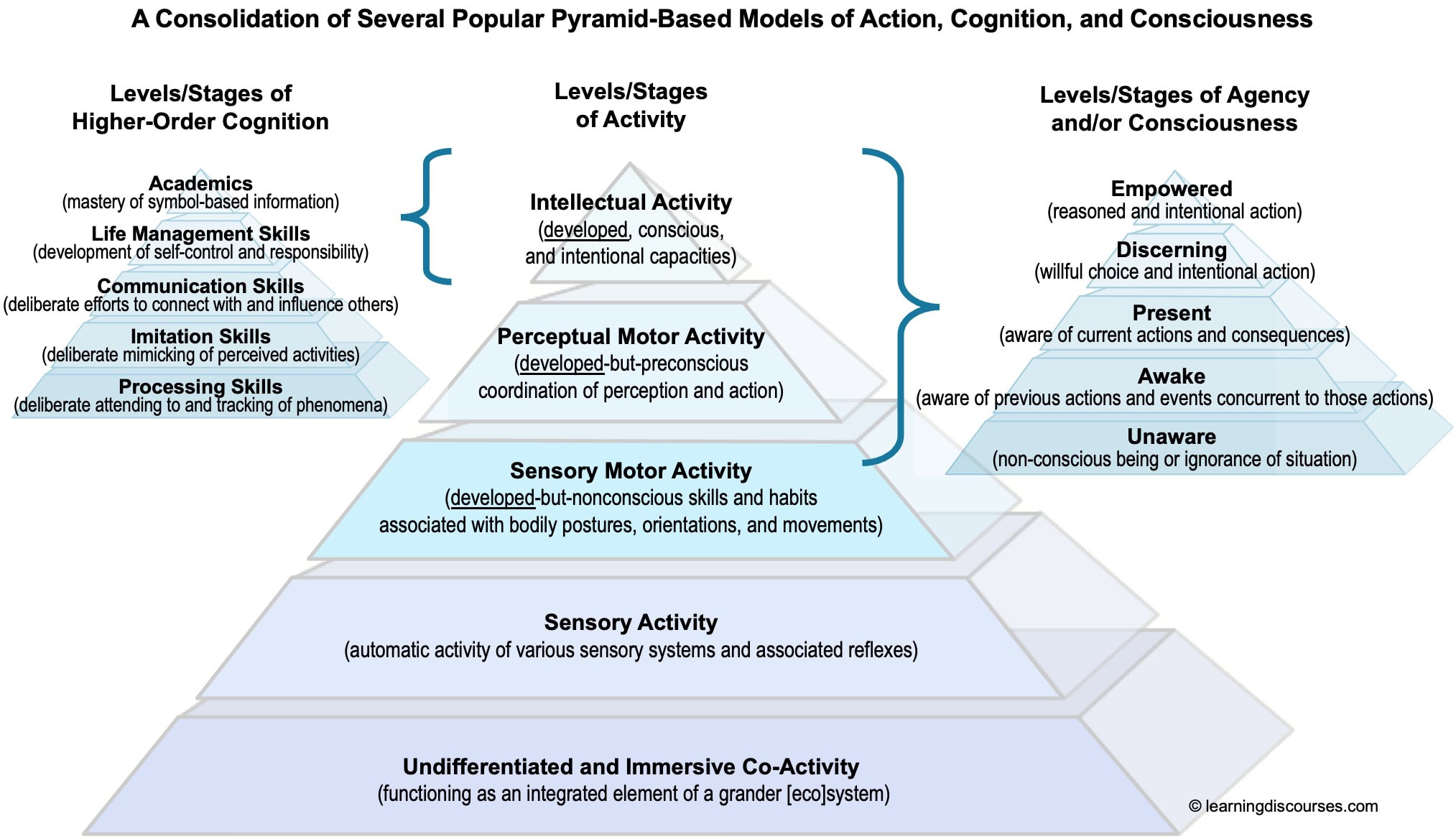 (For some specific pyramid-based models of learning, cognition, consciousness, and/or development, see, e.g., Learning Pyramid, Conscious Competence Model of Learning, DIKW Pyramid, and Maslow’s Hierarchy of Needs.)
Commentary
Developmental Discourses were initially criticized for models of growth and change that seemed to offer universal developmental stages, failing to account for differences across cultures and settings – i.e.:- Maturationism – the view that key changes in children’s abilities and learning occur primarily through biological maturation – i.e., unfolding “naturally” with age – so instruction has limited influence until the child is developmentally “ready”
- Adultomorphism – the inclination to reconstruct developmental models on the bases of adults’ memories, behaviors, and/or pathologies
Subdiscourses:
- Adultomorphism
- Baldwin Effect (Organic Evolution; Organic Selection)
- Character Development
- Child Development
- Circular Reaction
- Early Childhood Education (Early Years Education; Early Experience)
- Emotional Parentification
- Formation
- Genetic Logic
- Growth
- Hurried Child (Hurried Child Syndrome)
- Infantile Amnesia
- Instrumental Parentification
- Kierkegaard’s Model of Growth
- Lifespan Development Theory
- Liminality
- Maturational Lag
- Maturationism
- Multistage Theory
- Parentification (Parent–Child Role Reversal)
- Pedology
- Personality Development
- Positive Adult Development
- Psychonomics
- Pyramid Models of Action, Cognition, and Consciousness
- Retrogression
- Rousseau’s Theory of Development (Natural Development; Natural Education)
- Separation–Individuation
- System and Lifeworld (Lebenswelt)
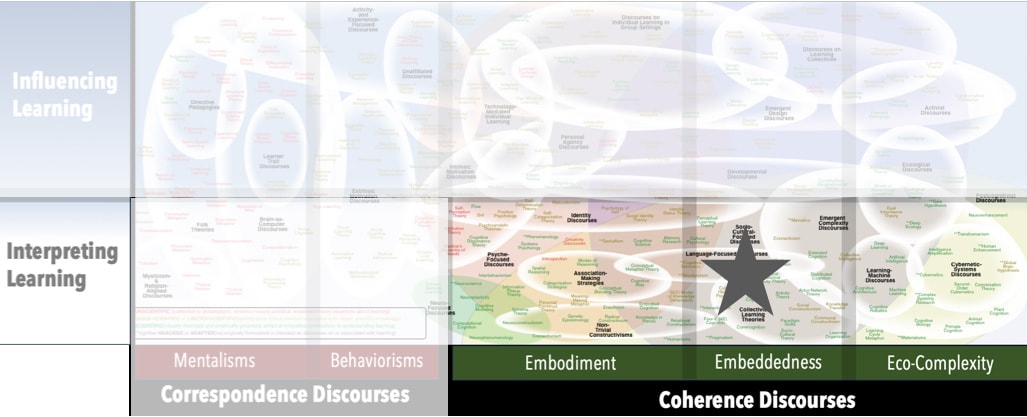
Map Location
Please cite this article as:
Davis, B., & Francis, K. (2026). “Developmental Discourses” in Discourses on Learning in Education. https://learningdiscourses.com.
⇦ Back to Map
⇦ Back to List