
Focus
The lived sense that existence is relational, meaningful, and more-than-materialPrincipal Metaphors
- Knowledge is … responsive doing and being
- Knowing is … living relationship
- Learner is … an embodied and embedded agent
- Learning is … situational and relational attunement
- Teaching is … being present; living an example; orienting
Originated
PrehistoricSynopsis
Spirituality refers to the lived sense that existence is relational, meaningful, and more-than-material. Across cultures, it has been expressed through ceremony, story, silence, song, land-based practice, responsive obligation, healing, contemplation, and encounters with mystery, spirit, ancestors, or the sacred. In today’s era of varied usage and conflicting meanings, Spirituality might be effectively characterized in terms of what it is not:- Mysticism– an umbrella term that refers to worldviews structured around the belief that reality exceeds human capacity to explain. “Knowledge” is understood to inhere in the cosmos and to be accessed through means of divination by humans. (Contrast: Religion.) For more detail, see Mysticism- & Religion-Aligned Discourses.
- Religion– any institutionalized system of belief, typically developed around the assumption that divine knowledge is revealed by a transcendent God or a pantheon of gods. Humans are obligated to organize their lives according to the strictures with those revelations. Religious myths and narratives are usually framed in terms of dichotomies that require some sort of resolution. (Contrast: Mysticism.) For more detail, see Mysticism- & Religion-Aligned Discourses.
- Hope – 1. (Spirituality) a trustful orientation toward life that sustains meaningful participation in the face of uncertainty. Hope is typically grounded in relationship with something larger than oneself – Creator, Spirit, community, ancestors, the land, the unfolding of life, or the future. 2. (Positive Psychology; Rick Snyder, 1990s) tethered to the Path-Following Metaphor, the belief that desired goals can be achieved, coupled with the perceived ability to find and pursue pathways toward them
- Secularism – a sociopolitical principle that insists on the separation of meaning-making, ethics, and institutions from religious authority
- Humanisms – ethical-philosophical worldviews that ground meaning, dignity, and responsibility in human capacities, relationships, and flourishing rather than divine or mystical authority
- Materialisms – views that reality is fundamentally physical, measurable, and explainable without appeal to the non-material – e.g., spirit, sacredness, or transcendence
- Rationalism – orientation that privileges reason, logic, and evidence as the primary grounds for truth and judgment. In its strong forms, Rationalism distrusts intuition, revelation, ceremony, embodied knowledge, ancestral knowledge, and spiritual experience.
- Ancestral Intelligence (ancient) – the accumulated adaptive knowledge, values, practices, and ways of understanding developed across generations and transmitted through biological inheritance, cultural learning, and – in many Indigenous traditions –ongoing relationships with ancestors
- Animist Spirituality (various, ancient) – the understanding of beings, places, objects, and forces as animate, relational, and spiritually present
- Being-Beyond-the-World (Uberwelt; Überwelt) (Ludwig Binswanger, 1930s) refers to the human capacity to transcend immediate circumstances and orient toward ultimate meanings, values, ideals, spirituality, and existential possibilities (Contrasts: Umwelt, under Semiotics; Being in the World, under Humanisms)
- Contemplative Studies (various, 1970s) – the examination of meditation, prayer, attention, embodiment, and contemplative traditions across cultures
- Ecospirituality (Ecological Spirituality) (various, 1980s) – a spiritual orientation that recognizes the interconnectedness and sacredness of all life, emphasizing reciprocal relationships with the Earth and ecological responsibility
- Indigenous Spirituality (ancient) – diverse, place-based traditions in which spirit, land, ancestors, community, ceremony, protocol, story, and responsibility obligations are inseparable. Indigenous Spirituality emphasizes being “in a good way” – entailing relational accountability, balance, reciprocity, and living in right relationship with human and more-than-human worlds.
- Integral Spirituality (Ken Wilber, 2000s) – an attempt to synthesize psychological, developmental, philosophical, and spiritual traditions
- Psychonautics – the exploration of altered states of consciousness, especially but not exclusively for spiritual purposes, as effected by meditation, substance, sensory deprivation, and/or extreme activity
- Psychospirituality (various, 1990s) – the meshing of psychological development, healing, meaning-making, and spiritual experience
- Somatic Spirituality (various, 1970s) – the connecting of spirituality with the body, breath, movement, trauma, and embodied awareness
- Spiritual Awakening – a transformative shift in awareness through which a person experiences a deeper sense of meaning, interconnectedness, purpose, or reality beyond their previously held assumptions about themselves and the world
- Transpersonal Psychology (Spiritual Psychology; Transpersonal Theory) (Abraham Maslow, Victor Frankl, 1960s) – a variously defined branch of Psychology that presses beyond the personal into matters of the spiritual and the transcendent. Topics encountered in Transpersonal Psychology include peak and mystical experiences, spiritual evolution, altered states of consciousness, developmental stages beyond the socialized adult, and connectedness with phenomena normally understood as exterior to or beyond the ego.
Commentary
The word “Spirituality” comes from the Latin spiritus “breathing,” so it shares a conceptual heritage with the words derived from psyche (Ancient Greek for “breath”) and anima (Latin for “breath”). These families of words are the constant exchange of air, the taking of what is needed to survive while returning what others need, and the enaction of the partiality of being. Here Spirituality is about holding to the ground, not grasping at the heavens. Spirituality is natural and physical, not supernatural or metaphysical. Rather, it is about ecological minding – inhabiting, habituating, and being cared for by while caring for. Thus, in contrast to the future-oriented, goals-driven qualities of much of contemporary formal education (esp. Standardized Education), notions that align with an educational attitude associated with Spirtuality include:- Becoming – the ongoing process through which individuals, relationships, communities, and ways of knowing emerge, develop, and transform over time. Becoming emphasizes growth, participation, identity formation, and continual change rather than fixed states or finished outcomes.
- Belongingness (Roy Baumeister, 1990s) – the need, capacity, or experience of being accepted, valued, included, and connected within meaningful relationships or groups
- Being Present (Presencing) – variously interpreted in current educational literature, we discern these prominent meanings: 1. (attentional presence) engagement, focused on the task, lesson, or interaction. 2. (relational presence) connection, being responsive to others, projecting connection and caring. 3. (pedagogical presence) active, intentional orchestration of learning experiences. 4. (mindful presence) non-judgmental awareness of the present moment, often linked to Mindfulness. 5. (authentic presence) bringing one’s genuine self into educational interactions. 6. (dialogic presence) being open to encounter, listening, and mutual meaning-making.
- Groundedness – variously interpreted in current educational literature, we discern these prominent meanings: 1. (experiential groundedness) learning rooted in direct experience, action, or lived reality. 2. (situational groundedness)knowledge connected to specific cultural, historical, social, or environmental contexts. 3. (epistemological groundedness)ideas or claims supported by evidence, observation, or experience. 4. (identity/relational/place-based groundedness) learning connected to who one is and where one belongs. 5. (emotional groundedness) stability, regulation, and resilience in the face of challenge or uncertainty.
Authors and/or Prominent Influences
Wildly diffuseStatus as a Theory of Learning
Spirituality is less a singular theory of learning and more a family of perspectives on how humans come to know, become, and relate. Across traditions, Spirituality tends to frame learning as holistic and transformative, involving mind, body, emotion, spirit, and relationship. Knowledge may arise through contemplation, story, ceremony, intuition, moral reflection, or lived experience.Status as a Theory of Teaching
Spirituality tends to frame teaching as holistic, responsible, relational, and transformative. The teacher may serve as guide, witness, Elder, mentor, or co-learner, with pedagogy grounded in story, ceremony, contemplation, dialogue, practice, and lived example rather than instruction alone.Status as a Scientific Theory
Spirituality has limited status as a scientific theory because it does not usually offer testable mechanisms, predictive models, or stable empirical constructs. Indeed, Spirituality is often described or defined as the opposite of science – but such an attitude betrays a profound ignorance of both Spirituality’s close attendance to primal experience and science’s history. To the latter point, much of contemporary science traces to of ancient and culturally embedded healing practices, translating them into secular clinical language, and severing them from their spiritual, communal, and ceremonial contexts. That is, the significance of Spirituality lies elsewhere: as an interpretive, existential, and cultural framework for making sense of experience, meaning, relationship, and transformation.Subdiscourses:
- Ancestral Intelligence
- Animist Spirituality
- Becoming
- Being-Beyond-the-World (Uberwelt; Überwelt)
- Being Present (Presencing)
- Belongingness
- Contemplative Studies
- Ecospirituality (Ecological Spirituality)
- Groundedness
- Indigenous Spirituality
- Integral Spirituality
- Psychonautics
- Psychospirituality
- Somatic Spirituality
- Spiritual Awakening
- Transpersonal Psychology (Spiritual Psychology; Transpersonal Theory)
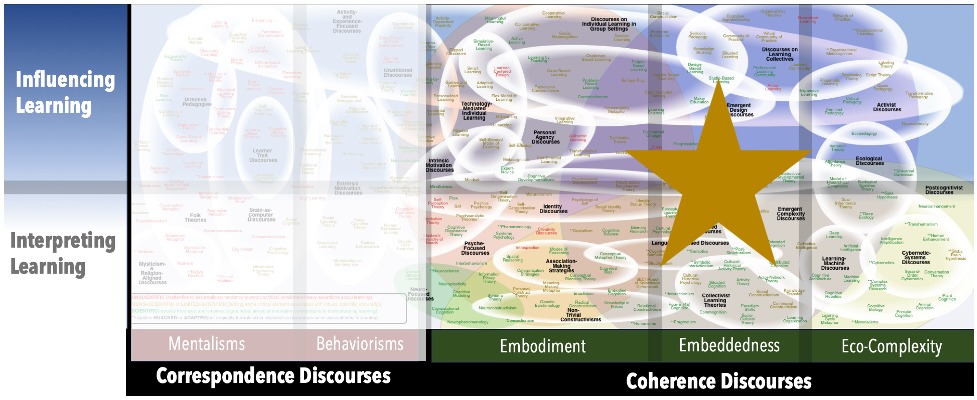
Map Location
Please cite this article as:
Davis, B., & Francis, K. (2026). “Spirituality” in Discourses on Learning in Education. https://learningdiscourses.com.
⇦ Back to Map
⇦ Back to List